90°How far you turn the bowl before drinking
1Sweet, eaten before the tea arrives
30 to 45 minTypical time kneeling in a classic session
The guest side, step by step
This follows the description of tea etiquette in the multilingual database of the Japan Tourism Agency. Hosts at visitor sessions show each step, so treat it as a preview rather than a test.
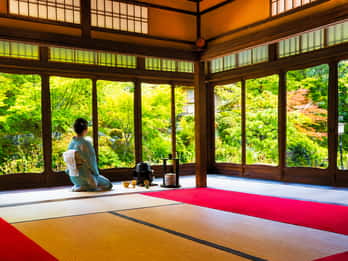
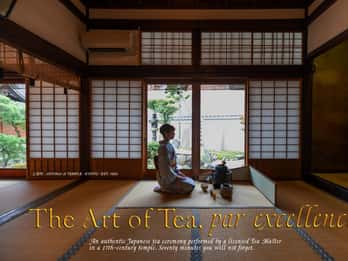
- Sit down, usually kneeling with your legs folded beneath you. Sitting cross-legged or to one side is acceptable.
- A plate with a wagashi sweet and a small wooden pick arrives. Lift the plate with your left hand, cut the sweet into pieces with the pick and finish it before the tea comes; it is there to balance the bitterness of the matcha.
- The bowl is placed in front of you and the host bows. Bow back with your fingertips on the floor in front of your knees.
- Pick the bowl up with your right hand and rest it on your left palm.
- Turn it a quarter clockwise. The host sets the front of the bowl towards you, and turning it means you do not drink from the front, a small gesture of modesty.
- Drink. Visitor sessions serve usucha, the thinner tea; thick koicha belongs to formal gatherings after a meal.
- Wipe the place where your lips touched the rim with the thumb and index finger of your right hand.
- Turn the bowl back so the front faces away from you again and set it down. You can admire it close to the floor.
- At the end the host explains the hanging scroll and the flowers in the alcove, which are chosen for the season.
At Sakaguchian you then whisk a second bowl yourself, and at Ju-An the session opens with a purification ritual at the temple water basin. Kimono packages follow the same order after the dressing.
What to wear and what to leave at home
You take off your shoes before the tatami room, so wear socks you are happy to show; at Roxcy socks are compulsory and bare feet are not allowed. Take off rings, watches and bracelets before you go in, because they can damage the bowls; etiquette guides suggest bringing a small case to keep them in. Skip strong perfume, which competes with the aroma of the tea, and tie long hair back so it stays out of the bowl. Clothes that let you kneel comfortably help more than formal ones; for kimono sessions, reviewers recommend something comfortable underneath.
House rules worth reading in advance
On top of the general etiquette, each house sets its own rules, mostly about punctuality, photos and what you carry in. These are the ones that most often surprise guests.
| Tea house | House rule | About |
| Sanjo Chasuian |
The door is locked at the start time; even one minute late means no entry |
Punctuality |
| Japan Wonder Travel |
No entry once the session has begun; arrive 5 minutes early |
Punctuality |
| Sakaguchian |
Booking can be cancelled from 10 minutes late; no luggage or large bags |
Punctuality, space |
| Roxcy |
Socks required; no strong perfume, large rings, bracelets or long necklaces; long hair tied up |
Protecting the bowls and the aroma |
| Sanjo Chasuian |
Socks required (sold at the door); no bicycles or motorcycles at the venue |
Tatami, neighbours |
| Éclat Japon |
Bring socks; no entry from 30 minutes late |
Tatami, punctuality |
| Midai |
No video recording |
Quiet room |
| Camellia Tea Ceremony |
Photos without flash, no video |
Quiet room |
| Camellia Flower Teahouse |
Photos and short videos allowed |
The exception |
Questions, photos and the language
Sakaguchian, Ju-An, Camellia Flower and Yumeyakata all invite questions, usually at the end. Photos are generally fine, video often is not; when in doubt, ask before you start filming. Several houses work with a tea master who speaks Japanese and a guide or interpreter who explains in English, so expect short pauses for translation. If you want explanations in another language, Éclat Japon offers its introduction in German, French, Italian, Spanish, Portuguese and Dutch, and the GOKU TRIP walk in Uji has guides in six languages.